***Disclaimer***

Disclaimer: The Wizard of 'OZ' makes no money from 'OZ' - The 'Other' Side of the Rainbow. 'OZ' is 100 % paid ad-free

Monday, March 03, 2008

The 411 - Alexander Graham Bell


Alexander Graham Bell (3 March 1847 - 2 August 1922) was an eminent scientist, inventor and innovator. Most often associated with the invention of the telephone, Bell was also called "the father of the deaf". His father, grandfather and brother had all been associated with work on elocution and speech, and both his mother and wife were deaf, profoundly influencing Bell's life's work. His research on hearing and speech further led him to experiment with hearing devices that eventually culminated in Bell being awarded the first U.S. patent for the invention of the telephone in 1876.

Alexander Graham BellMany other inventions marked Bell's later life including groundbreaking work in hydrofoils and aeronautics. In 1888, Alexander Graham Bell was one of the founding members of the National Geographic Society. In reflection, Bell considered his most famous invention an intrusion on his real work as a scientist and refused to have a telephone in his study. Upon Bell's death, all telephones throughout the United States "stilled their ringing for a silent minute in tribute to the man whose yearning to communicate made them possible."

Alexander Bell was born in Edinburgh, Scotland on 3 March 1847. Throughout his early life, Bell was a British subject. The family home was at 16 South Charlotte Street, Edinburgh and has a commemorative marker at the doorstep, marking this as Alexander Graham Bell's birthplace. He had two brothers: Melville James Bell (1845-1870) and Edward Charles Bell (1848-1867). Both of his brothers died of tuberculosis, Edward in 1867 and Melville in 1870. His father was Professor Alexander Melville Bell, and his mother was Eliza Grace (nee Symonds). Although he was born "Alexander", at age ten he made a plea to his father to have a middle name like his two brothers. For his 11th birthday, his father acquiesced and allowed him to adopt the middle name "Graham" chosen out of admiration for Alexander Graham, a Canadian being treated by his father and boarder who had become a family friend. To close relatives and friends he remained "Aleck" which his father continued to call him into later life.

First invention
As a child, young Aleck Bell displayed a natural curiosity about his world, resulting in gathering botanical specimens as well as experimenting even at an early age. His best friend was Ben Herdman, a neighbour whose family operated a flour mill, the scene of many forays. When their typical child's play had caused a racket one day, John Herdman admonished the two boys, "Why don't you do something useful?" Young Aleck asked what needed to be done at the mill. He was told wheat had to be dehusked through a laborious process and at the age of 12, Bell built a homemade device that combined rotating paddles with sets of nail brushes, creating a simple dehusking machine that was put into operation and used steadily for a number of years. In return, John Herdman gave both boys the run of a small workshop to "invent."

Early work with speech
From his early years, Bell showed a sensitive nature and a talent for art, poetry and music that was encouraged by his mother. With no formal training, he mastered the piano and became the family's pianist. Despite being normally quiet and introspective, he revelled in mimicry and "voice tricks" akin to ventriloquism that constantly entertained family guests. Bell was also deeply affected by his mother's gradual deafness (she began to lose her hearing when he was 12) and learned a manual finger language so he could sit at her side and tap out silently the conversations swirling around the family parlour. He also developed a technique of speaking in clear, modulated tones directly into his mother's forehead wherein she would hear him with reasonable clarity. Bell's preoccupation with his mother's deafness led him to study acoustics.

His family was associated with the teaching of elocution: his grandfather, Alexander Bell, in London, his uncle in Dublin, and his father, in Edinburgh, were all elocutionists. His father published a variety of works on the subject, several of which are still well known, especially his The Standard Elocutionist (1860) and treatise on Visible Speech, which appeared in Edinburgh in 1868. The Standard Elocutionist appeared in 168 British editions and sold over a quarter of a million copies in the United States alone. In this treatise, he explains his methods of how to instruct deaf-mutes (as they were then known) to articulate words and read other people's lip movements to decipher meaning. Aleck's father taught him and his brothers not only to write Visible Speech but also to identify any symbol and its accompanying sound.[18] Aleck became so proficient that he became part of his father's public demonstrations and astounded audiences with his abilities in deciphering Latin, Gaelic and even Sanskrit symbols.


Education
Although as a young child, like his brothers, Bell received his early schooling at home from his father, at an early age, he was enrolled at the Royal High School, Edinburgh, Scotland, which he left at age 15, completing the first four forms only. His school record was undistinguished, marked by absenteeism and lacklustre grades. His main interest remained in the sciences, especially biology with other school subjects treated with indifference, to the dismay of his demanding father. Upon leaving school, Bell went to London to live with his grandfather, Alexander Bell. During the year he spent with his grandfather, a love of learning was born, with long hours spent in serious discussion and study. The elder Bell took great efforts to have his young pupil learn to speak clearly and with conviction, the attributes that his pupil would need to become a teacher himself. At age 16, Bell secured a position as a "pupil-teacher" of elocution and music, in Weston House Academy, at Elgin, Moray, Scotland. Although he was enrolled as a student in Latin and Greek, he instructed in return for board and £10 per session. The following year he attended the University of Edinburgh; joining his older brother Melville who had enrolled there the previous year, and where Aleck intended to write exams but later graduated from the University of Toronto.


First experiments with sound
Bell's father encouraged Aleck's interest in speech and in 1863, took his sons to see a unique automaton, developed by Sir Charles Wheatstone based on the earlier work of Baron Wolfgang von Kempelen. The rudimentary "mechanical man" simulated a human voice. Aleck was fascinated by the machine and after he obtained a copy of von Kempelen's book published in Germany and had laboriously translated it, Aleck and his older brother Melville built their own automaton head. Their father, highly interested in their project, offered to pay for any supplies and spurred the boys on with the enticement of a "big prize" if they were successful. While his brother constructed the throat and larynx, Aleck tackled the more difficult task of recreating a realistic skull. His efforts resulted in a remarkably lifelike head that could "speak," albeit only a few words. The boys would carefully adjust the "lips" and when a bellows forced air through the windpipe, a very recognizable "Mama" ensued, to the delight of neighbors who came to see the Bell invention.

Intrigued by the results of the automaton, Bell continued to experiment with a live subject, the family's Skye terrier, "Trouve". After he taught it to growl continuously, Aleck would reach into its mouth and manipulate the dog's lips and vocal cords to produce a crude-sounding "Ow ah oo ga ma ma." With little convincing, visitors believed his dog could articulate "How are you grandma?" More indicative of his playful nature, his experiments convinced onlookers that they saw a "talking dog." However, these initial forays into experimentation with sound led Bell to undertake his first serious work on the transmission of sound, using tuning forks to explore resonance. At the age of 19, he wrote a report on his work and sent it to Alexander Ellis, a colleague of his father. Ellis immediately wrote back indicating that the experiments were similar to existing work in Germany. Dismayed to find that groundbreaking work had already taken place by Hermann von Helmholtz who had conveyed vowel sounds by means of a similar tuning fork "contraption", he pored over the German scientist's book, Sensations of Tone. From his translation of the original German edition, Aleck then made a deduction that would be the underpinning of all his future work on transmitting sound, "Without knowing much about the subject, it seemed to me that if vowel sounds could be produced by electrical means so could consonants, so could articulate speech."


Family tragedy
In 1865, when the Bell family moved to London, Bell returned to Weston House as an assistant master and in his spare hours, continued experiments on sound using a minimum of laboratory equipment. Bell concentrated on experimenting with electricity to convey sound and later installed a telegraph wire from his room in Somerset College to that of a friend. Throughout the fall and winter, his health faltered mainly through exhaustion. His younger brother, Edward "Ted" was similarly bed-ridden, suffering from tuberculosis. While Bell recovered (now referring to himself in correspondence as "A.G. Bell") and served the next year as an instructor at Somerset College, Bath, Somerset, England, his brother's condition deteriorated. Edward would never recover. Upon his brother's passing, Bell returned home in 1867. His older brother, "Melly" had married and moved out. With aspirations to obtain a degree at the University of London, Bell considered his next years as preparation for the degree examinations, devoting his spare time at his family's residence to studying.

Helping his father in Visible Speech demonstrations and lectures brought Bell to Susanna E. Hull's private school for the deaf in South Kensington, London. His first two pupils were "deaf mute" girls who made remarkable progress under his tutelage. While his older brother seemed to achieve success on many fronts including setting up his own school for elocution, applying for a patent on an invention, and beginning a family, Bell continued as a teacher. In May 1870, Melville died from complications of tuberculosis, causing a family crisis. His father had also suffered a debilitating illness earlier in life and had been restored to health by a convalescence in Newfoundland. Bell's parents precipitated a long-planned move when they realized that their remaining son was also sickly. Making a swift judgement, Alexander Melville Bell asked Bell to arrange for the sale of all the family property, conclude all of his brother's affairs (Bell took over a last student, curing a pronounced lisp) and join his father and mother in setting out for the "New World." Reluctantly, Bell also had to conclude a relationship with Marie Eccleston, whom he surmised was not prepared to leave England with him.


Canada
In 1870, at age 23, Bell, his brother's widow, Caroline (Margaret Ottaway), and his parents travelled on the SS Nestorian to Canada. After landing at Quebec City, the Bells boarded a train to Montreal and later to Paris, Ontario to stay with the Reverend Thomas Henderson, a family friend. After a brief stay with the Hendersons, the Bell family purchased a ten and a half acre farm at Tutelo Heights (now called Tutela Heights), near Brantford, Ontario. The property consisted of an orchard, larger farm house, stable, pigsty, hen-house and carriage house, bordering the Grand River.

At the homestead, Bell set up his own workshop in the converted carriage house near to what he called his "dreaming place," a large hollow nestled in trees at the back of the property above the river. Despite his frail condition upon arriving in Canada, Bell found the climate and environs to his liking, and rapidly improved. He continued his interest in the study of the human voice and when he discovered the Six Nations Reserve across the river at Onondaga, he learned the Mohawk language and translated its unwritten vocabulary into Visible Speech symbols. For his work, Bell was awarded the title of honorary chief and participated in a ceremony where he donned a Mohawk headdress and danced traditional dances.

After setting up his workshop, Bell continued experiments based on Helmholtz's work with electricity and sound. He designed a piano which, by means of electricity, could transmit its music at a distance. Once the family was settled in, both Bell and his father made plans to establish a teaching practice and in 1871, he accompanied his father to Montreal, where Melville was offered a position to teach his System of Visible Speech.

Telephone
By 1874, Bell's initial work on the harmonic telegraph had entered a formative stagebell speaking into the first telephone with progress made both at his new Boston "laboratory" as well as at his family home in Canada. While working that summer in Brantford, Bell experimented with a "phonautograph," a pen-like machine that could draw shapes of sound waves on smoked glass by tracing their vibrations. Bell thought it might be possible to generate undulating electrical currents that corresponded to sound waves. Bell also thought that multiple metal reeds tuned to different frequencies like a harp would be able to convert the undulatory currents back into sound. But he had no working model to demonstrate the feasibility of these ideas.

In 1874, telegraph message traffic was rapidly expanding and in the words of Western Union President William Orton, had become "the nervous system of commerce." Orton had contracted with inventors Thomas Edison and Elisha Gray to find a way to send multiple telegraph messages on each telegraph line to avoid the great cost of constructing new lines. When Bell mentioned to Gardiner Hubbard and Thomas Sanders that he was working on a method of sending multiple tones on a telegraph wire using a multi-reed device, the two wealthy patrons began to financially support Bell's experiments. Patent matters would be handled by Hubbard's patent attorney Anthony Pollok.

In March 1875, Bell and Pollok visited the famous scientist Joseph Henry, who was then director of the Smithsonian Institution, and asked Henry's advice on the electrical multi-reed apparatus that Bell hoped would transmit the human voice by telegraph. Henry replied that Bell had "the germ of a great invention". When Bell said that he did not have the necessary knowledge, Henry replied, "Get it!" That declaration greatly encouraged Bell to keep trying. Bell did not have the equipment needed to continue his experiments, nor the ability to create a working model of his ideas. A chance meeting in 1874 between Bell and Thomas A. Watson, an experienced electrical designer and mechanic at the electrical machine shop of Charles Williams, changed all that.

With financial support from Sanders and Hubbard, Bell was able to hire Thomas Watson as his assistant and Bell and Watson experimented with acoustic telegraphy. On 2 June 1875, Watson accidentally plucked one of the reeds and Bell at the receiving end of the wire, heard the overtones of the reed, overtones that would be necessary for transmitting speech. That demonstrated to Bell that only one reed or armature was needed, not multiple reeds. This led to the "gallows" sound-powered telephone, which was able to transmit indistinct voice-like sounds but not clear speech.

--more-

*Wikipedia

Musician Jeff Healey dies of cancer


Jack Spearman and Jessey Bird, Canwest News Service

Jeff Healey Guitar wizard Norman Jeff Healey of Toronto died Sunday of cancer. He was 41.

Healey was considered a prodigy and earned numerous Juno and Grammy nominations in the course of his career.

He lost both his eyes to retinoblastoma before he was eight-months-old, but never let that slow him down.

"What we've lost is a virtuoso musician," said Richard Flohil, Healey's publicist. "He followed his own passion, which oddly enough was not playing blues rock music, but playing classic rock jazz.

"He just cancelled a concert a few days ago in Nepean (Ont.) and we made this very kind of bland, not-to-worry statement," said Flohil. "At that point, we didn't want to say that Jeff was basically dying, although we all knew he was."

The Canadian blues and jazz great died in a Toronto hospital Sunday evening after a lifelong battle with cancer.

Flohil, who had been friends with Healey for about 20 years, said the news of his death will be very hard on his family, friends and fans. "He was lovely," said Flohil. "He was very generous, very warm-hearted, with a great sense of humour."

"He was just an awesome guitar player," said Danny Sivyer, owner of Ottawa blues bar The Rainbow Bistro. Sivyer said he brought Healey to The Rainbow Bistro for his first Ottawa gig when he was just 19-years-old. "He blew us away the first time we heard him." said Sivyer. "We were setting up, it was a busy night, and we looked over and there was this three-piece band with a blind 19-year-old musician."

"Then we sat down and listened and the whole room was stunned," said Sivyer. "Everybody loved him right away."

Healey was only three when he started to play guitar.

By the time he was a teenager, Healey had formed a four-piece band called the Blue Direction and was playing in clubs throughout the Toronto area. His best known work came when he formed the Jeff Healey Band several years later with bassist Joe Rockman and drummer Tom Stephen. His career took off when he appeared in the movie Road House, which starred Patrick Swayze.

In 1988, his Grammy-nominated album See the Light included the major hit single, Angel Eyes. In 1990, he earned the Juno for entertainer of the year.

Healey became an internationally-known star who played with musical greats that included B.B. King and Stevie Ray Vaughan.

--more--


*Canada.com

The pharmacist joke


RxSLIMMING DIET !
A woman walks into a pharmacy and purchases for $1200 worth of slimming products. She then asks the pharmacist:

"How much do you think I'm going to lose with that?"


The pharmacist answers:


"Close to $1200"


Sunday, March 02, 2008

The Fairy Godfather

Warning! Mature subject matter!

Click here
Click above

Free Puppy!


A friend of mine is looking for a good home for a puppy he recently acquired. This dog has had a troubled past, but with the right care and rehabilitation, he will most likely become a good and faithful friend.

Click here to see the cutie!

So That's How They Do It!!!

The Painter


Doug, the blonde, was getting pretty desperate for money. He decided to go to the nicer, richer neighborhoods around town and look for odd jobs as a handyman.

The first house she came to, a man answered the door and told Doug,"Yeah, I have a job for you. "How would you like to paint the porch?"

"Sure that sounds great!" said Doug.

"Well, how much do you want me to pay you?" asked the man.

"Is fifty bucks all right?" Doug asked.

"Yeah, great. "You'll find the paint and ladders you'll need in the garage."

The man went back into his house to his partner who had been listening. "Fifty bucks! Does he know the porch goes all the way around the house?" asked the partner.

"Well, he must, he was standing right on it!" the man replied.

About 45 minutes later, Doug knocked on the door. "I'm all finished," he told the surprised homeowner.

The man was amazed. "You painted the whole porch?"

"Yeah," Doug replied, "I even had some paint left, so I put on two coats!"

The man reached into his wallet to pay Doug. "Oh, and by the way," said Doug, "That's not a Porch, it's a Ferrari."


Cool Pictures

New Face On Mars Sighted!!!!


This is the one discovered just a few short months ago:

The First Face Discovered

Click on the picture above to see the latest sighting.

Are you feeling smart today - A Riddle


Eighty percent of Kindergartners solved this riddle, but only 5% of Stanford graduates figured it out!

Can you answer the following questions?

1. The word has seven letters...
2. Preceded God...
3. Greater than God...
4. More Evil than the devil...
5. All poor people have it...
6. Wealthy people need it...
7. If you eat it, you will die.


Did you figure it out?


Try hard before looking at the answers


Did you get it yet?


Give up?


Brace yourself for the answer....


The Answer is:


NOTHING! NOTHING has 7 letters.
NOTHING preceded God.
NOTHING is greater than God.
NOTHING is more Evil than the devil.
All poor people have NOTHING.
Wealthy people need NOTHING.
If you eat NOTHING, you will die.


Don't feel bad - I have to admit that I couldn't solve it either and had to look at the answer.


The Black Cat Maukie


If you tease her with the mouse pointer on her chest or stomach she will purr, and to get her to meeow, rub her forehead with the pointer.

If you make a slow circle around her body, (counterclockwise) not only will her head/eyes follow your pointer, but toward the top, her paw will go up, and when in front of her paws at the bottom, her foot comes out like she wants to play with your mouse pointer.

(Don't hold the mouse down, just move it)

Maukie

Click here.

Saturday, March 01, 2008

The Love Doctor


The Love Doctor Dear Love Doctor,

I’m in love with my sister’s girlfriend. Yes they are gay. I’m not. I’m a healthy, well-adjusted boy. I know that Marge does not like boys. She likes my sister more than anyone else. But the other day I winked at Marge and she winked back. I signaled her to meet me out in the barn. She did. Now she likes boys too. What should I do? I’m afraid that she will tell my sister on me.

Signed,

Farmed Out


Dear Farmed,

I should tell you to be frank with your sister. Tell her about your feelings for Marge. Since she is your loving sister, she will understand and let Marge go... BUT.... It would be not good to "IN" Marge to your sister. Gay people will think that she should have stayed Out of the closet! She will think that soon Marge will be participating in Straight PRIDE Parades and start having sex with alot of straight people. You know.. That straight 'thingy' is infective! Next thing she will think that Marge wants to have an opposite sex wedding! And in a Catholic Church - no less! And also, if you "IN" Marge, you may well be exposing her to not being accepted by the gay community! We can't have that! All hell would break loose--- all those children, being raised by broken marriages! Tell Marge to keep her big mouth shut!

The Love Doctor


The Pink Spotlight on Steve Walker

Someone to be loved

Someone To Be Loved
Click on the picture to goto his facebook fansite. Tons of homoerotic images available.

BIOGRAPHY: Drawing is one of Steve Walker's earliest childhood memories. He recollects drawing pictures from about the age of three or four years old. Drawing came naturally to the Toronto artist, and his love of the art form continued into his adulthood. As a self taught artist, Walker only began painting after a trip to Europe when he was 25 years old. During the trip, he spent much of his time in Europe touring the great galleries and museums. In his words it was the first time he was exposed to great painting, and the first time he recognized the potential power of the art form. "I was moved by something that I was capable of doing," he said. His first paintings were done in a somewhat secretive way, as he had no intention of exhibiting or selling, and had no aspirations of becoming a professional artist.

Producing art about his life and the lives of those around him is as natural to Walker as his first childhood drawings. As a gay man, Walker is acutely aware that he is living during a period of history that is both the best of times and the worst of times. There is more freedom and acceptance for gay men and women, while at the same time AIDS has devastated the gay population.

But Walker's paintings are not about gay people or homosexuality. He describes his art as being about love, hate, pain, joy, touch, communication, beauty, loneliness, attraction, hope, despair, life and death. His art includes universal themes regardless of race, gender, socio-economic class, culture or sexual orientation. However, his work is unique because he conveys these themes through the subjects in his paintings, young gay men. "Remove the gender of the painting's subjects and what we have is human relationships in general, and one's relationship to the world itself," he said. "As a homosexual I have been moved, educated, and inspired by works that deal with a heterosexual context. Why would I assume that a heterosexual would be incapable of appreciating work that speaks to common themes in life, as seen through my eyes as a gay man. If the heterosexual population is unable to do this, then the loss is theirs, not mine."

If Walker were an abstract painter or a landscape artist, he says his sexual orientation wouldn't matter. But since his paintings are about gay life, his sexual orientation becomes more important than his cultural background, age, or nationality.

The focus of his paintings often depict sadness and loneliness to reflect the reality that much of anyone's life is sad and lonely. Walker often portrays people in relationships as separate entities because that is the way he views them. He also uses a small and consistent palette of colours because he is comfortable with them and the colours provide the desired results. "Colour is very powerful and a little can go a long way if used effectively," he said. "Some colours are very exciting to me, while others are quite offensive. Painting flesh is very exciting because of the huge variations possible within a very small colour range."

Walker's artworks are very large, always measuring 36" by 48". He creates large paintings because he believes that a large image is more appealing than a smaller one. "Whether it's a television screen, cinema screen, or an image in a magazine, the size of the image connotes a degree of importance," he said. Walker said belonging to an oppressed minority group has been a driving force in creating his art. "Any minority wants and needs to find artistic voices that reflect their own personal situations, and, in doing so, validate and record their lives and cultures for themselves, and for the larger world," he said.

Walker said he experiences many small rewards during the creative process. "After hours of painting, I stand back and look at something that wasn't there before -- a hand, face, or piece of fabric will exist where there was once a blank canvas," he said.

As an artist, Walker said it's exciting to be working at a point in history where there is an audience ready to appreciate and consume his creations. "It is very rare to find success as an artist in your lifetime," he said. "My work will be around long after me, but seeing it affect people at the time that I am creating it is very rewarding."

In recent years Steve Walker's work has been exhibited in galleries in Toronto, Montreal, New York, Philadelphia and Key West.

The gay community of North America has responded very positively to Walker's art. "I am very aware of the appreciation from a group of people who recognize the time, energy and talent devoted to a body of work that speaks specifically to them but at the same time exists in the larger world that we all live in," he said.

&#185 ho·mo·e·rot·ic ( hō ' mō-ĭ-rŏt ' ĭk ) adj. Of or concerning homosexual love and desire. Tending to arouse such desire.

Dog Jong Game

Click here
Click above

TRUE or FALSE? YOU DECIDE!


Daniel Boone, and Paul Revere were the only three real people to have their likenesses featured on Pez candy dispensers.


Yep! The dispensers were issued as part of Pez’s U.S. Bicentennial series—in the only break with the company’s rule against likenesses of real people.

Smurf Pez
Not real people...REALLY!

--Wizard's Note: Elvis was another, really, I think...

Warning - Full of the F*ck Word


Warning - Full of the F*ck Word

Watch these in the order they are listed –

Sarah Silverman’s song to Jimmy Kimmel


Jimmy Kimmel’s response:


And the requisite spoof:

Warning - Full of the F*ck Word

Straight from the set of Kevin Smith’s Zack And Miri Make A Porno - starring Seth Rogen, Elizabeth Banks, Jason Mewes, Traci Lords, Craig Robinson, Jeff Anderson, Katie Morgan and Ricky Mabe - comes a decidedly NSFW cautionary tale about just what it takes to get ahead in Hollywood…

Click here.


*Thanks, Calvin

What does Love mean?


A group of professional people posed this question to a group of 4to 8 year-olds, "What does love mean?" The answers they got were broader and deeper than anyone could have imagined. See what you think:

"When my grandmother got arthritis, she couldn't bend over and paint her toenails anymore. So my grandfather does it for her all the time, even when his hands got arthritis too. That's love."
-----Rebecca- age 8


"When someone loves you, the way they say your name is different.You just know that your name is safe in their mouth."
-----Billy - age 4

"Love is when a girl puts on perfume and a boy puts on shaving cologne and they go out and smell each other."
-----Karl - age 5

"Love is when you go out to eat and give somebody most of your French fries without making them give you any of theirs."
-----Chrissy - age 6


"Love is what makes you smile when you're tired."
-----Terri - age 4

"Love is when my mommy makes coffee for my daddy and she takes a sip before giving it to him, to make sure the taste is OK."
-----Danny - age 7

"Love is when you kiss all the time. Then when you get tired of kissing, you still want to be together and you talk more. My Mommy and Daddy are like that. They look gross when they kiss"
-----Emily - age 8


"Love is what's in the room with you at Christmas if you stop opening presents and listen."
-----Bobby - age 7 (Wow!)

"If you want to learn to love better, you should start with a friend who you hate,"
-----Nikka - age 6 (we need a few million more Nikka's on this planet)

"Love is when you tell a guy you like his shirt, then he wears it everyday."
-----Noelle -age 7


"Love is like a little old woman and a little old man who are still friends even after they know each other so well."
-----Tommy - age 6

"During my piano recital, I was on a stage and I was scared. I looked at all the people watching me and saw my daddy waving and smiling. He was the only one doing that. I wasn't scared anymore."
-----Cindy - age 8

"My mommy loves me more than anybody . You don't see anyone else kissing me to sleep at night."
-----Clare - age 6


"Love is when Mommy gives Daddy the best piece of chicken."
-----Elaine-age 5

"Love is when Mommy sees Daddy smelly and sweaty and still says he is handsomer than Robert Redford."
-----Chris - age 7

"Love is when your puppy licks your face even after you left him alone all day."
-----Mary Ann - age 4

"When you love somebody, your eyelashes go up and down and little stars come out of you." (what an image)
-----Karen - age 7


"Love is when Mommy sees Daddy on the toilet and she doesn't think it's gross."
------Mark - age 6

"You really shouldn't say 'I love you' unless you mean it. But if you mean it, you should say it a lot. People forget."
-----Jessica - age 8

And the final one -- Author and lecturer Leo Buscaglia once talked about a contest he was asked to judge.

The purpose of the contest was to find the most caring child. The winner was a four year old child whose next door neighbor was an elderly gentleman who had recently lost his wife. Upon seeing the man cry, the little boy went into the old gentleman's yard, climbed onto his lap, and just sat there. When his Mother asked what he had aid to the neighbor, the little boy said, "Nothing, I just helped him cry."

Daddy Cut The Big One


Daddy Cut The Big One - Click here!


Click above

Got GRILLZ?


In hip-hop culture, the term grills refers to cosmetic dental metal apparatus featuring silver, gold, or platinum caps with diamond inlays (usually princess-cut diamonds) jewelled to be worn over the teeth.

Grills rose to prominence with Dirty South rappers in the 2000s as a symbol of their wealth and success, but earlier rappers such as Big Daddy Kane, Flavor Flav, and Kool G. Rap also wore them.

Horrorcore supergroup The Gravediggaz were well known for their vampiric fang grills in the early 90s. Grills have also been worn by some rock artists from Korn, Brooke Hogan, Marilyn Manson, Avenged Sevenfold and Dir en grey.

The video to the 2005 single "Grillz" (by Nelly, Paul Wall, Big Gipp, and Ali) showcases many common styles of grills. Grills can be purchased online or at specialty shops.

Grills are also known as Fronts, Golds, Plates, Gold Grills, Shines, Caps, Slugs, Pullouts.

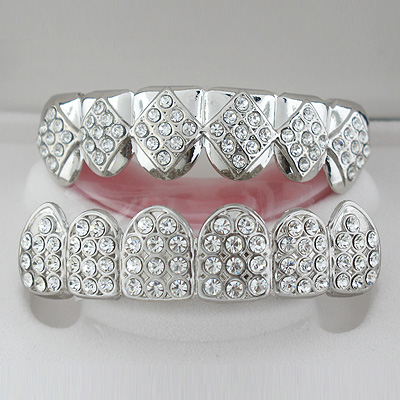
While some grills are made to be removable similar to that of an orthodontic retainer, others are permanently bonded to the teeth of their owners. Below is an example, available from IcedOutGear.com, and they are cheap ones! $69.99 USD. Grillz can go higher than $500.00 USD!:

Crystal Grillz

Specifications:
*The best of the Best of austrian crystal.
*Customize flex bar.
*Flex fit grillz (all shapes an Size of any teeth)
*So go and get YO Shine ON!

Description
The Grillz come in a semi precious metel with stones. One size fits all. There is no mold needed for this grill. It's just a minute away to get your own grillz. No more waiting for the molding and hassells. They do fit very well and they don't hurt your teeth or gums.

Advantages of these Grillz
1.Semi precious metal material.
2.The superior plating of nickel free RH.IPG which doesn't harm your body.
3.The differents with are company is that are grillz has been tested an is very safe and convenience for your use.
4.The fixing bar can use many times which makes easily to put it and out.
5.It's a FDA confirmation products that's why adhesive is not harm for body.
(code 175.300 TiTle 21(21CFR175.300)it's possible to use with metal safely.It provides capacity for protecting food between material, and also using the products safely that never happened other chemical material)

Care Instructions
1.Maintain normal hygiene, you should rinse the grillz in cold soapy water after each use.
2.Store Grillz in the box supplied.
3.Do not use solvents to clean.
4.Do not place in boiling water or leave on parcel shelf of car.
5.Your grillz is made for you.do not let others use it.

Disclaimer
These grillz are intended for decoraton and entertainment purpose only. They are not intended for eating.
These products are sold as it is without warranties of any kind.
We will not be liable for any damages of any kind arising from the use of these grillz including but not limited to incidental, punitive or accidental damages.


The Rolls Royce


A guy driving a Yugo pulled up to a stoplight next to a Rolls-Royce.

He rolled down his window and shouted to the driver of the Rolls. "Hey, buddy, that's a nice car. You got a phone in your Rolls? I've got a phone in my Yugo!"

The driver of the Rolls looked over and said snobbishly, "Yes, I have a phone."

The driver of the Yugo said, "Cool! Hey, you also got a fridge in there, too? I've got one in the back seat of my Yugo!"

The driver of the Rolls, much annoyed, says, "Yes, I have a refrigerator."
The driver of the Yugo said, "That's great, man! Hey, you got a TV in there? You know, I got a TV in the back seat of my Yugo!"

The driver of the Rolls, quite irritated by now, replied, "Of course, I have a television. A Rolls-Royce is the finest luxury car in the world!"

The driver of the Yugo said, "Yes, a very cool car! Hey, you got a bed in there? I got a bed in the back of my Yugo!"

The driver of the Rolls, upset that he did not have a bed, sped away and went straight to the dealer, where he promptly ordered a bed to be installed in the back of his Rolls-Royce.

The next morning, he returned to pick up his car, and the bed looked superb It came complete with silk sheets and a brass-trimmed headboard. It was clearly a bed fit for a Rolls-Royce. So the driver of the Rolls began searching for the Yugo. He drove around all day and finally found the Yugo late that night.

It was parked, with all the windows fogged up from the inside. He got out and knocked on the window of the Yugo. When there wasn't any answer, he continued knocking and knocking until finally, the owner of the Yugo lowered the window, and stuck his soaking wet head out.

"I now have a bed in the back of my Rolls-Royce," the driver of the Rolls stated arrogantly.

The driver of the Yugo looked at him narrowly and said, "You got me out of the shower to tell me THIS ?!?!"